Understand the target
Inspect homologs, alignment quality, and the biological relationship between chains. Form a hypothesis about what limits the current prediction.
Under review at ICLR 2027
An autonomous agent designs target-specific MSAs through biological reasoning and confidence-guided experiments with a frozen AlphaFold 3 predictor.
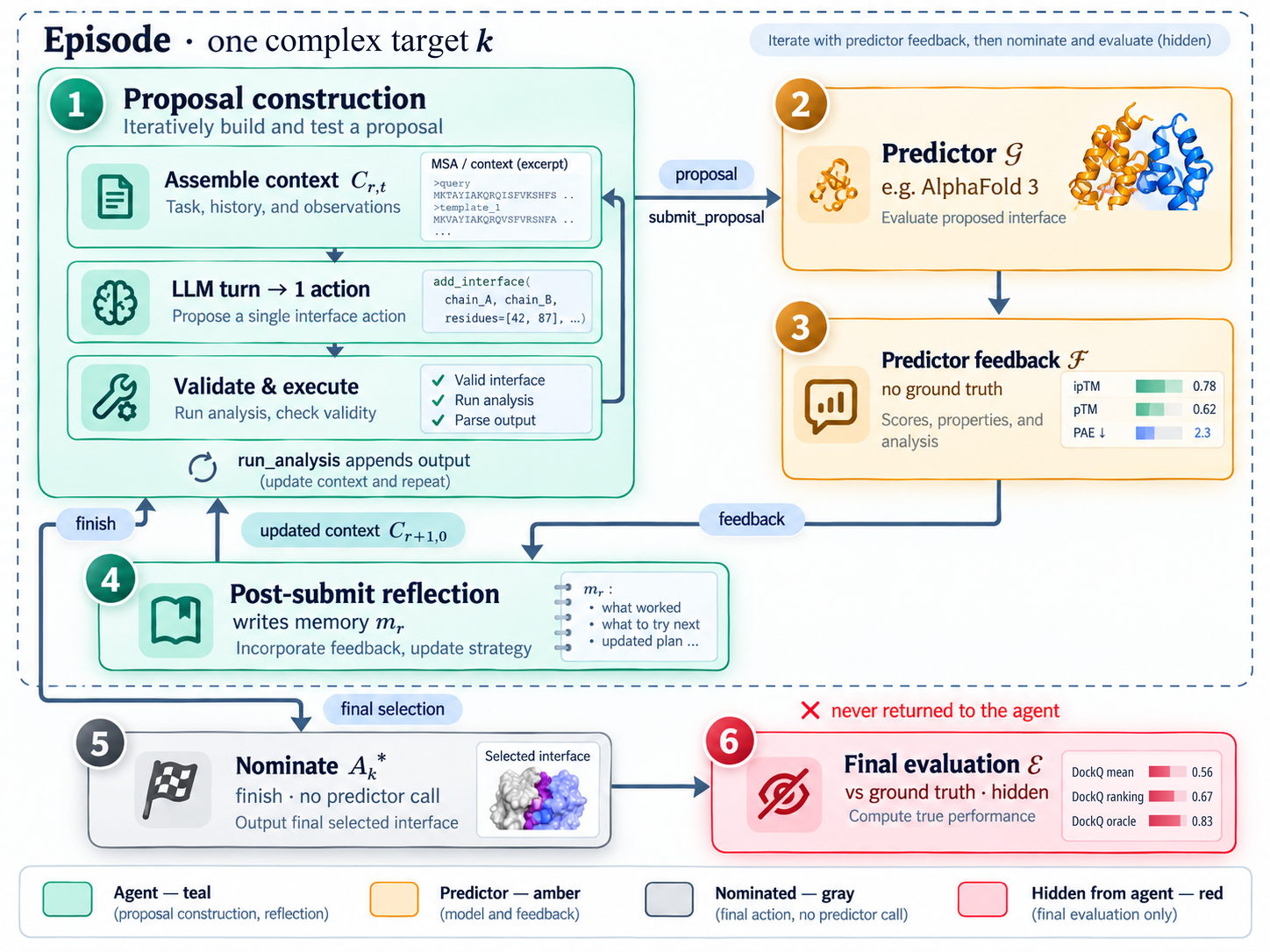
Which homologs matter? How deep should the alignment be? Which chains should be paired? The answers depend on the target. The agent reasons about the biology, writes analysis programs, and revises its proposals using AlphaFold 3’s confidence and structural outputs.
Protein-complex structure prediction with AlphaFold 3 depends on MSA content, depth, and cross-chain pairing. Current pipelines apply uniform recipes, typically maximizing depth and pairing by species, yet even whether cross-chain pairing helps AF3 remains contested. We show that the value of both depth and pairing is strongly target-dependent, so no single recipe is optimal across interfaces. We introduce an autonomous agent that treats a frozen AF3 as a black-box experimental instrument. For each target, the agent formulates biological hypotheses, analyzes and reorganizes the MSA, and iteratively refines sequence selection and pairing using predictor label-free signals alone. On 1,015 protein–protein interfaces from three benchmarks released after AF3’s training cutoff, the agent improves overall interface DockQ over AF3’s default pipeline and fixed MSA recipes on every benchmark, while using on average 60% fewer MSA sequences than the default. Gains are largest for inter-species heteromers, where species-based pairing is unreliable: mean DockQ increases from 0.465 to 0.612 on FoldBench and from 0.482 to 0.562 on HD439. The improvements arise from both sequence construction and pairing policy, including deliberate non-pairing. These results recast MSA design as a target-specific problem and show that an autonomous agent can adapt it at test time through biological reasoning and self-directed, confidence-guided experimentation.
An inner analysis loop constructs each proposal. An outer experiment loop uses predictor feedback and structured memory to guide the next.
Inspect homologs, alignment quality, and the biological relationship between chains. Form a hypothesis about what limits the current prediction.
Write executable builders to select, filter, reorder, and combine sequences. Control cross-chain pairing and deliberate non-pairing.
Run frozen AF3 and inspect 25 structure samples, ipTM, PAE, pLDDT, interface geometry, and consistency across predictions.
Record what worked in structured round memory, revise the hypothesis, and eventually nominate one previously evaluated candidate.
METHOD IN ACTION
See how a hypothesis becomes an MSA experiment, evidence, and the next decision.
8P9C · p63 / p73 / designed DARPin
Example target · offline Default → selected DockQ
Round memory informs the next diagnosis; finish by nominating a tested candidate.
INPUTS → HYPOTHESIS
Drag to rotate · Metrics average 25 predictions
01 DIAGNOSE · ROUND 1 / 6
Observed
Learned
Next step
Pairing changes are drawn from the agent’s recorded MSA designs.
The agent achieves the highest overall mean DockQ on all three evaluated benchmarks, using approximately 40% of the default MSA depth on average.
278 interfaces · 238 targets
Mean over 25 structures per interface, then averaged equally across interfaces. Values from Table 1. Additional predictor calls are used for search.
Compare Default with the agent, or select a type to see all five methods above.
Interface categories and values from Table 1. HD439 contains heterodimers only.
238 matched targets · 278 interfaces. Compare predictor-guided Blind search with a GT-guided agent that can inspect reference structures and DockQ feedback.
278 interfaces · matched FoldBench v1 targets
Blind nomination is the agent’s actual choice. Blind best tested is the retrospective best DockQ per interface among its tested proposals, including Default. GT-guided final is the actual final submission selected by target-mean DockQ.
Reference feedback helps the agent discover stronger proposals. Choosing among the proposals it has already tested also matters.
Blind → GT-guided · all interfaces
Final Blind gain: +0.020 · all interfaces
| Interface type | n | Default | Blind nomination | Blind best tested | GT-guided final | GT final − Blind best |
|---|
GT-guided search is an oracle-feedback ablation; ground truth is unavailable to the main Blind agent. Both settings use the same AF3 configuration (5 seeds × 5 samples, 10 recycles), with early termination allowed; realized search effort can differ. GT selection eliminates target-level nomination regret, while small interface-level regret can remain for targets with multiple interfaces. Results from Table 9.
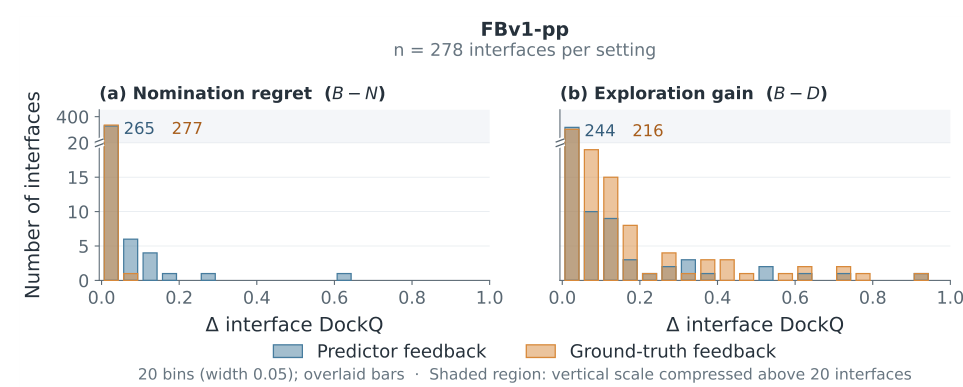
Finding a better proposal is only half the story. Under predictor feedback, exploration gains can be lost when confidence favors a different candidate. The selected cases below highlight the largest improvements; benchmark results above cover the full evaluation.
Selected from completed searches across three benchmarks, including FoldBench v1 GT-guided episodes.
Ordered by nominated mean DockQ gain over Default. Blind uses predictor feedback, with DockQ evaluated offline. GT-guided has access to reference structures and DockQ. Each search mode is a separate case.
Loading case studies…
More rows can introduce redundancy or mismatched homologs. Target-specific filtering and rebalancing make shallower alignments effective.
Pairing and deliberate non-pairing are both design choices. On intra-species HD439 heteromers, the pairing policy contributes about half of the gain.
Structured reflection connects biological hypotheses with predictor feedback and guides the next executable MSA proposal.